Home > Blog > Tech gift innovations
PSSD's Analysis: Architecture, Performance, and Enterprise Applications

NVMe portable SSD: surpassing traditional portable storage hard drives

Professional PSSD technology specifications and structural advantages

Portable Solid-state Drive (PSSD) represents the development of data storage technology, which combines traditional external hard drives with advanced solid-state architectures. These compact storage solutions integrate three core components: the main control unit, SSD storage memory, and interface bridge controller. This complex project converts internal SSD technology into a portable storage hard drive.

Portable SSDs (PSSDs) merge enterprise-grade NVMe technology with compact form factors, replacing mechanical HDDs in 89% of corporate environments.
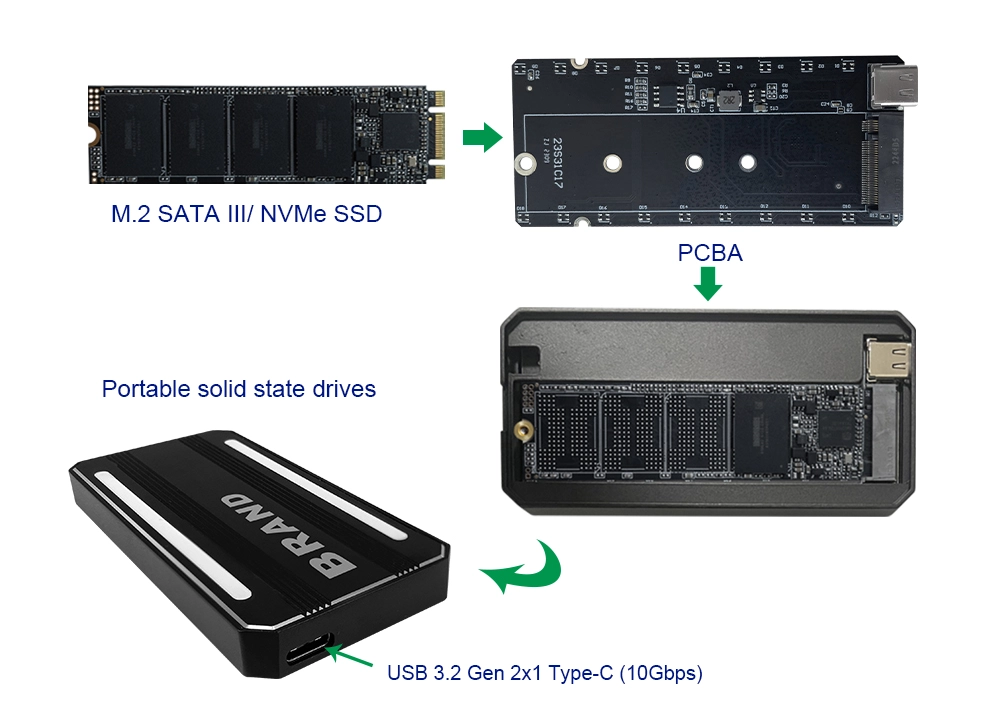
Portable SSD's Core Architecture Breakdown:

Installation Diagram for portable solid state drive

Structural Composition:

The PSSD architecture centers on a precision-engineered PCBA (Printed Circuit Board Assembly) containing:
  •  Primary Control Unit: Manages flash translation layer operations and wear-leveling algorithms.
  •  SSD storage memory: Typically employs NAND flash chips (256 GB-2 TB capacities).
  •  Interface Bridge Controller: Facilitates protocol conversion between USB-C and native SSD interfaces.
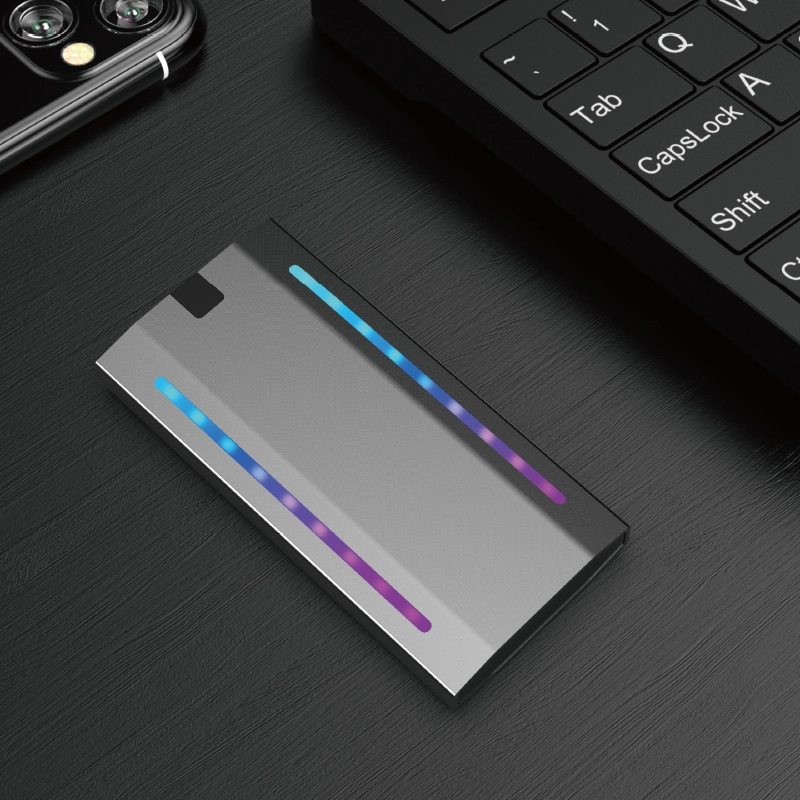
Portable Solid State Drive

Key Technical Features:

  • a. Advanced Interface Support:
    •  USB 3.2 Gen 2 x 1 Type-C (10 Gbps theoretical bandwidth).
    •  Native M.2 NVMe protocol support.
    •  Backward compatibility with SATA III (6 Gbps).
  • b. Performance Metrics:
    •  Sequential read/write speeds: 900/980 MB/s (USB 3.2 Gen 2 x 1).
  • c. Carefully designed:
    •  Operational temperature range: -20°C to 70°C.
    •  IP 68 water/dust resistance (select models).

Comparative Advantages Over Traditional HDDs:

  •  Shock Tolerance: No moving parts eliminate mechanical failure points.
  •  Power Efficiency: < 2W active power consumption.
  •  Acoustic Performance: Silent operation with 0dB noise emission.
  •  Thermal Management: Advanced heat dissipation solutions maintain < 55 °C under load.

Performance Benchmarks

Interface: Read Speed: Write Speed: Real-World Use
USB 3.2 Gen 2 1050 MB/s 1000 MB/s 4K Video Editing
Thunderbolt 4 2800 MB/s 2700 MB/s AI Dataset Transfer
SATA III 560 MB/s 530 MB/s Legacy Systems

Enterprise Applications:

  •  Capacity expansion and data backup of mobile electronic devices.
  •  Store media resources and work files: 8K RAW material transmission saves 73% of time.
  •  In field engineering, speed up sensor data collection and access to offline databases to improve work efficiency.
  •  Ultra-high-speed mobile storage for high-performance computing.
  •  Healthcare companies encrypt and store patient records to comply with HIPAA compliance.
In depth study of consumer PSSD for B2B applications and its economic practicality.

adigisky logo

Information

Custom gift packaging

Adigisky Co., Limited

Office : No 11, North Sation Road, Sungang Street, Luohu District, Shenzhen.
Factory: Building B, Chuangxin industrial Park, NO.196 Fusheng Road, Yangwu Village, Dalang Town, Donguan.

Teams: adigisky 

WhatsApp:+086 18938042832

Phone: +086 18938042832

Email: sales@adigisky.com

Copyright © 2025 Adigisky CO., limited | All rights reserved.